DonkeyMails.com: No Minimum Payout

Wednesday, August 7, 2013

Ramadan Special: Night of Reward of Lailatul Jaiza or Night Preceding Eid ul-Fitr


Eid al-Fitr is an Islamic festival. It takes place at the end of 
the month of Holy Ramadan, a month of fasting when people 
don't eat and drink during the day or we can say that month 
of Holy Ramadan concludes with the celebration of Eid al-Fitr 
and Eid-ul-Fitr is celebrated on the first day of the month of 
Shawwal.

Eid-ul-Fitr marks the end of the month of Holy Ramadan. We 
say farewell to the blessed month, its beautiful days and its 
fragrant nights. We leave the month of seeking nearness to 
Ar-Rahmaan, the school of Imaan and an opportunity to 
recharge our spiritual batteries.

Is Eid (festival) a sign of happiness that Holy Ramadan has finished? 
As a matter of fact, it is quite the opposite! It is a celebration of 
thanks to Allah (SWT) for giving us the chance and the strength 
to carry out His commands in the blessed month of Holy Ramadan. 

We are happy that we were able to fast and pray in Holy Ramadan 
and have hopefully increased in Taqwa (God-consciousness).

Allah (SWT) says in Surah al-Baqarah, Ayat 185: 
"You shall complete the number (of days) and you may glorify 
God for His guiding you, and that you may be thankful."

Imam Ali (as) says: "Eid is for him whose fasts have been 
accepted by Allah (SWT) and whose worship has been appreciated 
by Allah (SWT). Everyday in which you do not disobey Allah (SWT) 
is a day of Eid."

Holy Prophet Muhammad (saw) and the Imams celebrated Eid and 
encouraged all Muslims to do so. They told Muslims to wear good 
clothes, put on perfume, and go to the mosque to recite the Eid 
prayer. 

They also said to exchange Eid greetings, visit each other, and 
generally pass the day joyfully. We should remember the poor by 
taking out Fitrah before Eid, and visiting them and sending them 
gifts if we can.

The day of Eid is meant for remembering Allah (SWT). Holy Prophet 
Muhammad (saw) says: "Give beauty to your Eid by doing Takbir". 
It is said that Holy Prophet Muhammad (saw) himself used to come 
out of his home on the day of Eid, reciting the Takbir and glorifying 
Allah (SWT) in a loud voice.

After being absorbed in a month long exercise of vigorous worship 
and spiritual enrichment, the Muslim Ummah stands on the threshold 
of Eid-ul-Fitr. 

The day of Eid is one to express sincere gratitude to Almighty Allah 
(SWT) for His favours - gratitude for the opportunity to fast through 
the day, stand in prayer at night, give charity and recite Holy Quran 
abundantly. It is a day of celebration for the believers who have 
executed their duties honorably.

Eid is the culmination of this spiritual empowerment and a festival 
marking the accomplishment of all Muslims. However, it does not 
signal the end of the mission. The good discipline developed in 
Holy Ramadan must remain and be sustained. A true reflection of 
our efforts in Holy Ramadan being accepted is continuity with 
good actions post Holy Ramadan.

Whilst the day of Eid is a joyous occasion the night should be one of 
contemplation and worship. It had been the practice of Holy Prophet 
Muhammad (saw), that he would not sleep in the night preceding 
the day of Eid-ul-Fitr. This night has been named in a Hadith as 
the Night of Reward (Lailatul Jaiza). 

Almighty Allah (SWT) bestows his rewards on those who have spent 
the month of Holy Ramadan abiding by the dictates of Shari'ah, and 
all their prayers in this night are accepted. Therefore, it is desirable 
to perform Nafl prayers in this night.

Holy Prophet Muhammad (saw) is reported to have said: 
"Whoever stands up (in worship) in the nights preceding the two Eids 
expecting rewards from his Lord, his heart will not die when the 
other hearts will die." (Ibn Majah)

Holy Prophet Muhammad al-Mustafa (saw) said: 
"I swear by Him Who has sent me with the truth as Prophet; 
Archangel Gabriel has reported to me from Archangel Israfel who 
directly reports from Almighty Allah (SWT) that one who offers 
this prayer, (at the last night of Ramzan al-Mubarak) will not raise 
his head from prostration before Almighty Allah (SWT) would forgive 
him, accept his acts during the month of Ramzan, and overlooks 
his sins ..." (Mafatih al-Jinan)

To benefit from this opportunity, one should perform as much worship 
in this night as he can and should pray for all his needs and desires.

Surely for those who repented profusely in the month of Holy Ramadan 
and used the auspicious month in the best possible way to gain proximity 
to their Creator, the day of Eid is one of true joy and celebration. 

They know well that they have seized the opportunities that availed 
in Holy Ramadan, and have firm hope in the reward and pleasure of 
their Creator. 

On the other hand those who squandered the opportunities, 
procrastinated in their repentance, and did not seize the blessed 
moments, will be left to regret their failure. 

Eid is a sweet sour occasion for such people, as they eat, meet, and 
greet with a regretful heart and look back at what could have been 
a life changing experience.

Our life is no different. The month of Holy Ramadan may be likened 
to the entire life span of a person and the day of Eid likened to the 
day a person will meet Allah (SWT). 

Every day is an opportunity to run towards Allah (SWT) and those who 
seize the opportunity of life and fulfill life's objective will be truly 
celebrating 'tomorrow', on the day of Qiyamah, when mankind will 
stand before their Lord. Holy Quran urges a believer 'to run to Allah' 
and 'hasten to the forgiveness of your Lord and paradise.'

Just as Holy Ramadan comes and goes in flash, so will life. The end of 
each Holy Ramadan signifies the inevitable end of our lives. Whilst 
one may have some hope that if this Ramadan was squandered, 
Allah (SWT) may give life until another, there is no such hope for 
the journey of life, for when the 'Ramadan' of life is over then it 
shall never return. So, if we have been unmindful, we have a chance 
with every moment of life to repent and mend our ways. For a 
believer who spent his life fruitfully, the meeting with his Creator 
will be the Eid of all Eids.

We ask Allah (SWT) to bless us this Eid-ul-Fitr and give us such a bond 
and relationship with him that will grant eternal happiness on the day 
we return to Him.

Sunday, August 4, 2013

Do's and Don'ts of Ramadan 2013

 
Do's of Ramadan 2013:
 
1) Be sharing, caring and forgiving.
 
2) Control anger, emotions, carnal desires and furtive glances.
 
3) Adopt Sabr (patience) and Inculcate tolerance.
 
4) Adopt steadfastness and consistency in Ibadah (worship).
 
5) Recite Holy Quran extensively as much as possible
with understanding.
 
6) Give Zakat and Sadaqah with a good feeling keeping
the concept of collectivism in mind.
 
7) Sympathize with the poor, needy and the have-nots (Muwasaat).
 
8) Pay Zakat correctly but ensure you also clear your loans and dues.
 
9) Observe discipline, obedience and punctuality.
 
10) Practice Time Management and willpower.
 
11) Perform Qayamul Layl (Tahajjud) without a break.
 
12) Do keep yourself busy with Zikr and Dua.
 
13) Perform Nawafil prayers whenever you find the time.
 
14) Keep Roza /Sawm (fast) with enthusiasm.
 
15) Look forward eagerly to obtain the blessing of Laylatul Qadr
by observing Etikaaf if possible and pray all night at least in
the odd nights of the last 10 days and not 23rd or 27th night alone.
 
Don'ts of Ramadan 2013:
 
1) Don't turn month of fasting into month of feasting.
 
2) Don't waste time back biting, gossiping, cheating and arguing.
 
3) Don't waste time shopping during Ramadan.
 
4) Don't pay too much emphasis on food and drinks especially
during iftar time and don't spend too much time in kitchen either.
 
5) Don't waste time over-eating.
 
6) Don't mix fasting with dieting (Niyat of fasting is important).
 
7) Don't enter into controversies, conflicts and quarrels.
 
8) Don't delay iftar and don't miss Suhoor.
 
9)Don't conduct or attend ceremonial iftar as it
becomes barrier towards going Masjid.
 
10) Don't make yourself appear dull or present excuses
on account of your fasting.
 

Friday, August 2, 2013

Itikaf is a form of worship during Ramadan

Itikaf is a form of worship. It is formed by staying in a Mosque 
for a certain time. It is Ehtiyat that one should stay with the 
intention to worship Allah by praying formal or informal prayers 
although prayer is not a condition therein.

The time for this form of worship could be anytime when one is 
allowed to fast. The best time is the month of Ramadan, especially, 
the last ten days.


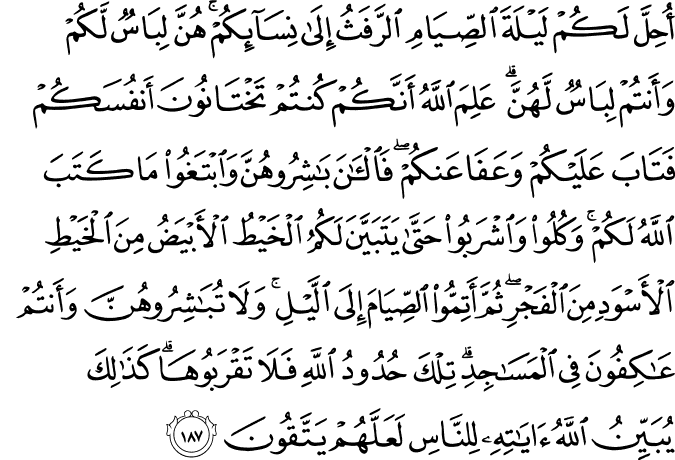
Holy Quran Says
"It has been made permissible for you the night preceding fasting 
to go to your wives [for sexual relations]. They are clothing for you 
and you are clothing for them. Allah knows that you used to deceive 
yourselves, so He accepted your repentance and forgave you. So now, 
have relations with them and seek that which Allah has decreed for you. 
And eat and drink until the white thread of dawn becomes distinct 
to you from the black thread [of night]. Then complete the fast 
until the sunset. And do not have relations with them as long as 
you are staying for worship in the mosques. These are 
the limits [set by] Allah , so do not approach them. 
Thus does Allah make clear His ordinances to the people that 
they may become righteous."

Surat Al-Baqarah (2:187)(The Cow) - Ø³ÙˆØ±Ø© البقرة


Conditions for I'tikaf during Ramadhan:
1. Intention as in the rest of the worship acts. It is necessary that 
the intention be made at the beginning of Itikaf so that the rule, 
requiring the worship act to be completed with intention, be 
followed thoroughly from the beginning to the end. 

The decision made at the beginning of the night to start Itikaf from 
the beginning of the following day will be open to objection. 
However, if one decides to start it from the beginning of the night 
it is not an offense to do so.

One is not allowed to change one's mind from one Itikaf to another of 
the same qualities or different.
2. Belief in Islam.
3. Freedom from mental illness.
4. Fasting; thus the Itikaf of one who cannot fast for some reason 
is not valid.
5. Duration; which is three continuous days at least. It could be more 
but not less than three days.

If it is started from the beginning of a day the two nights in between 
will be part of the duration. Less than three days is not considered Itikaf.

That it must take place in one of these Mosques: 
(a) The holy Mosque in Makkah, 
(b) the holy Mosque of the Prophet in Medina, 
(c) the holy Mosque of Kufa, 
(d) the holy Mosque of Basrah, and 
(e) the Mosque which is assigned for the Friday prayer in any town or city. 

It is Ehtiyat, however, to complete it in any of the first four Mosques.

The roof and basement of a Mosque is part of the same and it is valid 
to complete Etikaf in such places of a Mosque.

Permission of the people whose permission are required such as the 
master for the slave, husband and parents for the wife and children 
if this will be against the right of the husband or causes trouble to 
the parents.

6. Completing it in the Mosque where it was started. Thus, going out 
of the Mosque without an acceptable reason will invalidate the Itikaf, 
regardless, one knows the rule or is ignorant or has gone out because 
of forgetfulness, except in the case of an emergency or one being 
forced or it is because of some need such as using wash room or 
having Taharat.

One is allowed to come out of the Mosque during Itikaf to take part 
in the burial of a deceased or to visit an ailing one; Going out of 
the Mosque for a time long enough to cause the Itikaf to become 
as non-existing will be considered as invalidating the same, even 
if one has not done it out of one's own choice.

If one needs to have Ghusl/bath during the Itikaf and it is possible 
for him to have it inside the Mosque, and is not allowed to go 
out unless the reason for Ghusl requires him not to stay inside 
the Mosque.

Etikaf is originally an optional worship act but it may become 
obligatory because of a vow etc.

Things to avoid during Itikaf:
1. Having sex and also according to Ehtiyat kissing or playing 
with one's wife;

2. According to a necessary Ehtiyat causing a semen discharge,

3. And smelling perfumes for enjoyment; it is not an offense if 
one cannot enjoy the perfume because of some defect in his 
smelling ability.

4. Selling or buying in the form of a business deal, according to 
a necessary Ehtiyat; there is no offense to be occupied with 
allowable activities as sewing or writing etc., although it is 
a Mustahab Ehtiyat to avoid them too.

If one needs to buy something for food and there is no one to do 
the buying for him, it is not an offence for him to do it.

5. Expressing bitterness in talking about worldly or religious 
matters in order to prove one's ability, not the truth which is 
one of the best worships.

The contracts of buying or selling during Itikaf invalidate Itikaf, 
but such contracts will be valid.

If Itikaf is invalidated because of having sex even, during the night, 
expiation will be due; if it is invalidated by other things, there 
will be no expiation, although it is a Mustahab Ehtiyat in this case too.

The expiation for invalidating an Itikaf is to set free a slave or if 
this is not possible, fast for two consecutive months or if this also is 
not possible, feed sixty poor people.